










Key takeaways:
-
- AI agent development has become a core part of enterprises throughout multiple industries. Also, it has brought ease among people as it gives solutions to every problem.
- The average cost to create an AI agent in 2026 can be between $8,000 and $30,000. The final cost is driven by factors like platform choice, security, design, backend, and more.
- As per the recent study by Grand View Research, the AI agent market is predicted to reach USD 182.97 billion by 2033.
- With the right development strategy, features, and money-making models, businesses can build AI agents that are future-ready.
AI has become a part of daily life, helping us in our daily routine, whether communicating or shopping. AI has been adopted by many enterprises to streamline business operations.
But instead of generative AI applications, AI agents have taken innovation to another level. These agents are everywhere, whether in healthcare assisting with treatment or in finance analyzing risks immediately.
With the growing impact of AI across industries, the adoption of agents is increasing worldwide. Therefore, developing an AI agent in this world is like creating a tool that understands the core and provides logical solutions.
Writing rigid code is outdated now; you have to shape a system that thinks, decides, and then responds. This guide lets us explore how to build an AI agent that not only responds but takes action.
What Exactly Is an AI Agent: Explain with Use Cases
An AI agent is a software program that understands the need and works according to that. It is an independent system that takes action and decides what to do by itself. It is different from generative AI; it understands the user’s needs and works according to that.
AI agents adapt to ever-changing situations and perform with minimal human intervention. They analyze the information, give responses, and automate tasks differently across various systems. It comes with machine learning, LLMs, and Natural Language Processing services.
Have a look at the AI agent use cases and examples in different industries:
- Finance: AI agents offer fraud detection, trading automation, and risk management utilizing actual data analysis in the finance industry.
- Healthcare: These agents also give assistance in diagnosis, monitor patients, and provide personalized suggestions for treatment.
- Manufacturing: In this sector, AI agents manage production by analyzing equipment failure to reduce downtime.
- E-Commerce & Retail: Agents help by offering suggestions on the latest trends while shopping and by improving the customer experience.
- Logistics & Supply Chain: Such agents are used to improve route planning, inventory management, and delivery efficiency.
The Future of AI Agents: Market Growth & Predictions
The AI agents market is witnessing outstanding and explosive growth worldwide. This is due to enterprise adoption, automation demand, and advancements in generative AI technologies across industries. Have a look at the analysis and conclusions made by Grand View Research.
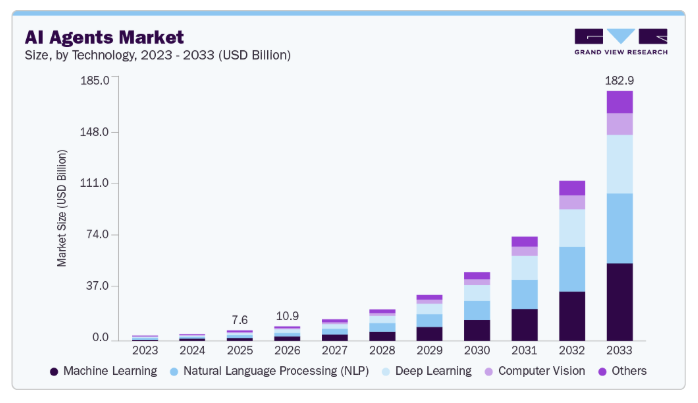
- The global AI agents market reached USD 7.63 billion in 2025.
- The market is projected to surge to USD 182.97 billion by 2033.
- A remarkable CAGR of 49.6% between 2026 and 2033 highlights rapid adoption across multiple industries.
- North America led the market in 2025, accounting for a dominant 39.63% revenue share globally.
- Increasing enterprise automation and generative AI integration are key drivers accelerating AI agent market growth worldwide.
Important Types of AI Agents Driving Intelligence & Automation
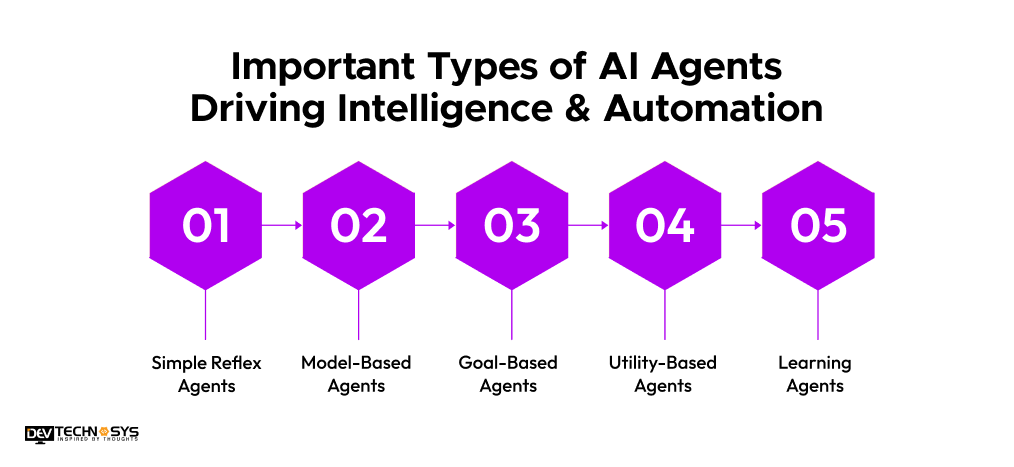
Simple Reflex, Model-Based, Goal-Based, Utility-Based, and Learning agents are some of the essential types of AI agents. These types work on different environmental inputs, whether simple rule-based tasks or complex learning systems. We will now describe these types that are driving innovation, intelligence, and automation.
1. Simple Reflex Agents
Simple reflex agents act only on current input using predefined rules. These agents do not store the memory and learn from the actions made in the past. They are suitable for predictable environments where quick, rule-based decisions are sufficient.
2. Model-Based Agents
Model-based agents store an internal memory of past actions. This helps them understand how the environment works. Model-based agents make better decisions even when the information is incomplete or changes from time to time.
3. Goal-Based Agents
By the name, it is clear that goal-based agents make decisions as per the desired result. They analyze multiple actions and select the one that takes them towards the specific goal. Goal-based agents are more flexible and intelligent than others.
4. Utility-Based Agents
Utility-based agents work beyond goals and examine how good every response is. They pick the actions that provide maximum satisfaction and benefits. It is a most useful and preferred agent in complex scenarios, as it offers multiple outcomes.
5. Learning Agents
Learning agents learns from data and past experiences and improve their performance over time. They adapt to new situations on their own and refine the final decisions. They optimize the action continuously without requiring human input.
Industry Insight:
AI agent implementation can significantly reduce operational costs. Some enterprises are reporting up to 50% savings in customer support and in supply chain operations- GlobleNewswire
How to Build an AI Agent Step By Step?
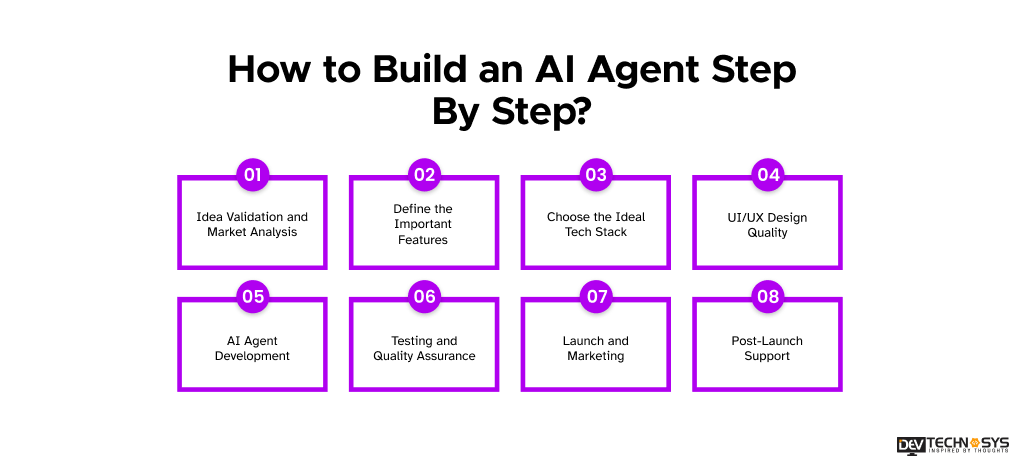
An AI development company builds an agent with a strategic development process. This process includes every essential stage, from idea validation and market research to after-launch support.
Every single step of the AI agent tutorial ensures an effective, scalable, and aligned AI agent. Understand the AI agent development guide and create an AI app or agent seamlessly.
1. Idea Validation and Market Analysis
The process of AI agent development for business begins with validating your idea and analyzing the market. This includes the study of the competitors, target audience, market demand, and industry trends.
At this stage, you will understand whether your idea is viable or not and can solve real problems for the users. It will give you a clear view of the idea and market before final development begins.
2. Define the Important Features
Highlight the key features that an agent should have for AI workflow optimization. The important features include automation, proactiveness, context retention, tool usability, and decision-making algorithms in AI.
It is mandatory to prioritize the features that align with user needs and business goals. When the feature set is well-defined, it avoids scope creep, inefficiencies, and resource wastage. Features added thoughtfully will guarantee efficient development.
3. Choose the Ideal Tech Stack
The technology stack for agent development includes the selection of programming languages, frameworks, and AI models. An ideal tech stack choice considers scalability, performance, and integration capabilities.
Picking the right tech stack ensures that the AI agent works with proper efficiency and effectiveness. The chosen tech stack must evolve with future advancements and business growth. An AI Agent development company chooses a tech stack with low maintenance costs.
4. UI/UX Design Quality
The design of the interface should be user-friendly, allowing users to interact with the AI agent effortlessly. The design quality should focus on the app’s responsiveness, clarity, and simplicity. If the UI/UX is good, it enhances user satisfaction to another level.
The design quality of an AI agent should improve user engagement and retention. With this, complex AI functionality becomes easy to understand and use for people.
5. AI Agent Development
The best frameworks for AI agent development include multiple advanced technologies. This includes the integration of machine learning models, natural language processing, and automation workflows.
In this stage, the idea of an AI agent gets transformed into a fully built, functional solution. It guarantees that the data is handled properly with a seamless system architecture. An AI chatbot development company creates a solution that is capable of analyzing data and making decisions.
6. Testing and Quality Assurance
Now, it’s time to test the AI agent in a detailed manner to get quality assurance before launching. This step includes identifying bugs, performance issues, and problems that might occur later.
It is really necessary to maintain quality assurance so that the agent works as expected. It also assures it delivers results with proper accuracy and provides a seamless user experience before launch.
7. Launch and Marketing
As your agent is all set, you can launch it to the target platform with AI model deployment strategies. But deploying an AI agent is not enough; you have to implement marketing strategies. These strategies let the solution reach the targeted audience through promotions.
Businesses can use SEO, social media, and paid campaigns to generate awareness. If it is released with strong marketing, the AI agent builds credibility.
8. Post-Launch Support
A company offering AI Agent development services can also help in monitoring the app’s performance continuously. Also, regular updates according to users’ feedback help the AI agent remain successful in the long run.
This stage also involves bug fixing, improving features, and adapting to changing user needs. It is important to keep the AI agent relevant and enhance user satisfaction through continuous improvement.
Want a chatbot demo or pricing? Fill the form and talk to our experts today.
Pick what you need below — you can select more than one — then tap Get detail to continue.
-
Chatbot demo dashboard
-
Cost to develop an app
-
Industry report
-
Case study
What are the Core Features of an AI Agent?
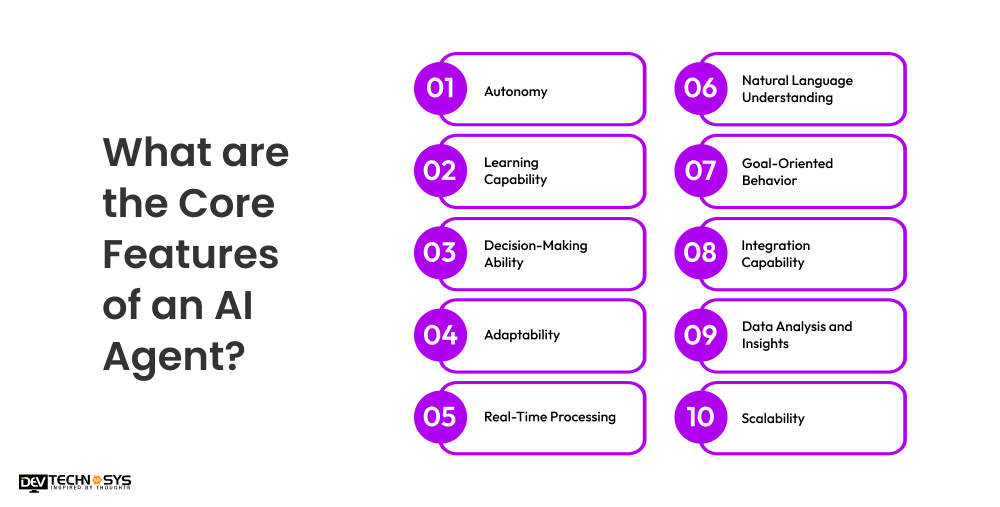
AI agents are designed to perform intelligent tasks autonomously by combining data processing, decision-making, and continuous learning. Their core features enable them to adapt, interact, and deliver efficient outcomes across industries, making them essential for modern automation and smart applications.
1. Autonomy:
AI agents operate independently without constant human intervention. They analyze inputs, make decisions, and execute actions on their own, improving efficiency and reducing manual effort in complex and repetitive tasks.
2. Learning Capability:
AI agents learn from data and past experiences using machine learning. This allows them to improve accuracy over time, adapt to new situations, and continuously enhance performance without requiring constant reprogramming.
3. Decision-Making Ability:
AI agents evaluate multiple options and choose the best course of action based on data, rules, or goals. This enables them to solve problems effectively and respond intelligently in dynamic environments.
4. Adaptability:
AI agents can adjust their behavior based on changes in the environment or user input. This flexibility ensures they remain effective even in unpredictable or evolving conditions.
5. Real-Time Processing:
AI agents can process data instantly and respond in real time. This is crucial for applications like fraud detection, customer support, and autonomous systems where immediate action is required.
6. Natural Language Understanding:
AI agents can understand and process human language through NLP. This allows them to interact with users via text or voice, making communication more intuitive and user-friendly.
7. Goal-Oriented Behavior:
AI agents are designed to achieve specific objectives. They evaluate actions based on how effectively they help reach defined goals, ensuring purposeful and efficient task execution.
8. Integration Capability:
AI agents can connect with other systems, APIs, and platforms. This enables seamless data exchange and allows them to function across multiple tools and environments efficiently.
9. Data Analysis and Insights:
AI agents analyze large volumes of data to extract meaningful insights. This helps businesses make informed decisions, identify trends, and optimize operations.
10. Scalability:
AI agents can handle increasing workloads without significant performance loss. They can scale across users, tasks, or systems, making them suitable for growing businesses and large-scale applications.
Industry Insight:
Research estimates that by 2026, around 40 % of enterprise applications will include task‑specific AI agents- The Cloud Standard
Why Should Entrepreneurs Invest in Developing an AI Agent?
Investing in an AI agent is becoming a strategic move for entrepreneurs aiming to scale operations, reduce costs, and stay competitive. AI-driven solutions enhance efficiency, improve customer experiences, and unlock new revenue opportunities, making them essential for modern, technology-driven business growth.
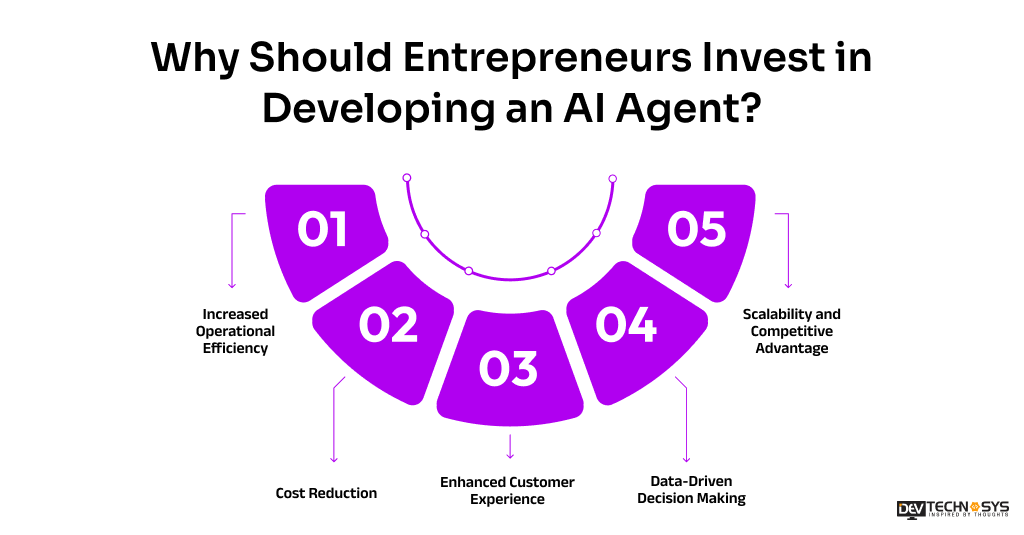
1. Increased Operational Efficiency
AI agents automate repetitive and time-consuming tasks, allowing businesses to operate faster and with fewer errors. This reduces manual workload, improves productivity, and enables teams to focus on high-value activities that drive growth and innovation.
2. Cost Reduction
By automating processes and minimizing human intervention, AI agents help reduce labor and operational costs. Businesses can achieve more with fewer resources, making AI a cost-effective investment for startups and growing enterprises aiming to maximize profitability.
3. Enhanced Customer Experience
AI agents provide instant responses, personalized recommendations, and 24/7 support. This improves customer satisfaction, engagement, and retention, helping businesses build stronger relationships and stand out in competitive markets.
4. Data-Driven Decision Making
AI agents analyze large volumes of data to generate actionable insights. Entrepreneurs can make informed decisions, identify trends, and optimize strategies, leading to better business outcomes and reduced risks.
5. Scalability and Competitive Advantage
AI agents easily scale with business growth, handling increasing workloads without compromising performance. Early adoption also gives entrepreneurs a competitive edge, enabling innovation, faster service delivery, and stronger market positioning.

How Much Does it Cost to Build an AI Agent?
The average cost to develop an AI agent can be commonly estimated from $8,000 to $30,000. This budget range can be determined according to the agent’s complexity. We will understand it like this:
- A basic system that is created with an MVP structure has less complexity. It leads to a development price range between $8,000 and $16,000.
- A mid-level solution is developed with a combination of basic and advanced integration, resulting in moderate complexity. Due to this, the development expense can be from $16,000 to $23,000.
- A full-fledged, highly advanced AI-powered solution has been developed with higher complexity. This keeps the cost range between $23,000 and $30,000.
For more clarity, we will understand the concept of cost through a breakdown table:
Features / Scope |
Basic |
Mid-Level |
Advanced |
| Cost Range | $8,000–$16,000 | $16,000–$23,000 | $23,000–$30,000 |
| Automation Level | Basic | Moderate | High |
| AI Capabilities | Rule-based | NLP + ML | Advanced AI models |
| Integrations | Limited | Standard APIs | Complex integrations |
| Scalability | Low | Medium | High |
Apart from complexity, there are multiple factors that can affect the AI agent development cost in 2026. These factors include UI/UX design, tech stack, platform selection, security, maintenance, development team, and their location. We will learn about these factors below with separate cost-explaining tables:
1. Developer’s Location
The cost to build an AI agent is affected by the developer’s location, as different regions have different per-hour costs. Developers from Australia and Western Europe have higher per-hour development prices. Whereas developers hired from regions like Latin America and Eastern Europe are inexpensive.
Region Type |
Estimated Cost |
Description |
| Offshore (Asia, Eastern Europe) | $1,500 – $3,000 | Cost-effective development with skilled talent |
| Nearshore | $3,000 – $4,500 | Balanced cost and communication efficiency |
| Onshore (USA, UK) | $4,500 – $6,000 | Higher cost with premium expertise and collaboration |
2. Post-Deployment Maintenance
After launching the AI agent, a mobile app development company works on its continuous maintenance and updates. This includes bug fixes, performance optimization, security patches, and system monitoring. Ongoing maintenance increases the cost to make an AI agent, but stabilizes its efficiency and security.
Maintenance Level |
Estimated Cost |
Description |
| Basic Support | $800 – $2,000 | Bug fixes and minor updates |
| Standard Maintenance | $2,000 – $3,500 | Performance monitoring and updates |
| Advanced Support | $3,500 – $5,000 | Continuous optimization and upgrades |
3. Backend Infrastructure
Maintaining backend infrastructure includes strong servers, databases, cloud services, and APIs. Integrating a scalable and high-performance backend involves a higher cost to create an AI agent. However, it ensures better reliability, faster processing, and seamless AI agent performance across systems.
Infrastructure Type |
Estimated Cost |
Description |
| Basic Setup | $3,000 – $6,000 | Standard servers and limited scalability |
| Scalable Infrastructure | $6,000 – $10,000 | Cloud-based with moderate scalability |
| High-Performance Systems | $10,000 – $15,000 | Advanced infrastructure for large-scale AI operations |
4. Security and Compliance
To handle sensitive user data, encryption, authentication, and regulatory standards are needed. It affects the cost to build artificial intelligence project, like AI agents, but ensures data protection. This also generates user trust and allows businesses to meet legal requirements as per their respective industries.
Security Level |
Estimated Cost |
Description |
| Basic Security | $2,000 – $3,500 | Standard encryption and authentication |
| Advanced Security | $3,500 – $5,000 | Enhanced data protection and monitoring |
| Compliance-Ready Systems | $5,000 – $6,000 | Meets industry regulations and standards |
5. Development Team
The cost to develop an AI agent also depends on the selection of freelancers, in-house teams, and development agencies. Freelancers are cost-effective but can only manage small projects.
In-house teams offer good control over projects but work on a monthly salary basis. While development agencies provide end-to-end and scalable solutions, they cost more.
Team Type |
Estimated Cost |
Description |
| Freelancers | $3,000 – $6,000 | Cost-effective for small-scale projects |
| In-House Team | $6,000 – $10,000 | Better control but higher operational costs |
| Development Company | $10,000 – $15,000 | Full-service expertise with scalable solutions |
Looking for the Best AI Agents in the World? Here’s the List
There are so many leading AI agents that have emerged with the rapid growth of AI agent development 2026. They offer automation, intelligent assistance, and advanced decision-making capabilities. Here we have a list of the top AI agents popular worldwide.
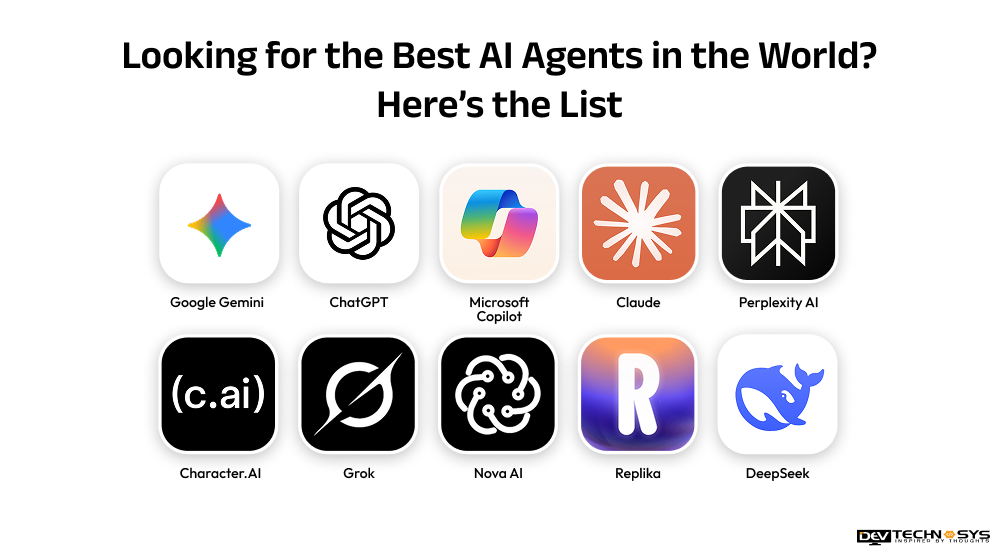
App Name |
Launch Year |
Platform Availability |
Rating |
Downloads |
| ChatGPT | 2022 | Web, iOS, Android | 4.7/5 | 250M+ |
| Google Gemini | 2023 | Web, iOS, Android | 4.5/5 | 80M+ |
| Microsoft Copilot | 2023 | Web, Windows, iOS, Android | 4.4/5 | 50M+ |
| Claude | 2023 | Web, iOS | 4.6/5 | 10M+ |
| Perplexity AI | 2022 | Web, iOS, Android | 4.6/5 | 10M+ |
| Grok | 2023 | Web, iOS | 4.3/5 | 50M+ |
| Character.AI | 2022 | Web, iOS, Android | 4.5/5 | 30M+ |
| Nova AI | 2023 | iOS, Android | 4.4/5 | 30M+ |
| Replika | 2017 | iOS, Android | 4.3/5 | 10M+ |
| DeepSeek | 2023 | Web, iOS, Android | 4.4/5 | 70M+ |
Now we will learn about the top 5 AI agents that transformed the way people think, analyze, and make decisions. Some of the best agentic AI developments include:
1. ChatGPT
Is there anyone who isn’t familiar with ChatGPT? It is one of the widely used AI agents globally. It is popular for advanced conversational abilities, content making, and problem-solving. ChatGPT is among the versatile cognitive computing solutions that support businesses and individuals.
2. Google Gemini
Another well-known AI Agent is Google Gemini, which supports real-time data and multimodal capabilities. It is integrated with Google’s ecosystem for intelligent search, content generation, and productivity support. It is ideal for users looking for accurate insights and seamless digital assistance.

3. Microsoft Copilot
Microsoft Copilot is also included in the list of top AI agent platforms. It integrates AI in multiple tools like Word, Excel, and Teams. Microsoft Copilot automates tasks, creates new content, examines data, and enhances workflows. For those working on the Microsoft ecosystem, Copilot can be a strong choice.
4. Perplexity AI
Perplexity AI is also a search and answer engine powered by AI. It provides exact, real-time, and data-oriented responses with accurate sources. People use it for research, quick insights, and knowledge discovery. Perplexity AI is a more reliable and interactive option than a traditional search engine.
5. Nova AI
Nova AI is a user-friendly AI assistant that is designed for content creation. It is used by many people for casual conversations and everyday productivity. Its features deliver writing assistance, brainstorming, and quick responses. Nova AI is popular among users as a simple yet effective AI-powered tool.
Industry Insight:
Companies using AI agents report up to 61 % higher employee efficiency and a 128 % average ROI in customer service domains- DK.Agents
What Monetization Models Can Be Implemented in AI Agents to Generate Revenue?
AI agents are becoming an integral part of businesses to enhance their operations and user experience. Therefore, selecting the right models to generate continuous profits through these agents is really important. Along with subscription, enterprise licensing, and advertising, we will learn several monetization models.
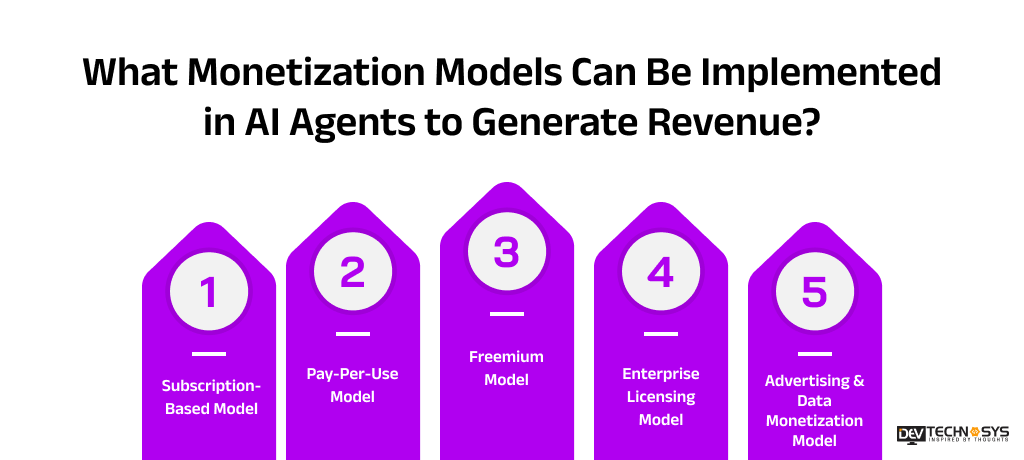
1. Subscription-Based Model
In a subscription-based model, users are asked for a fee to access advanced features. This fees can be recurring monthly, quarterly, or yearly. It ensures a predictable revenue while encouraging user retention in the long term.
2. Pay-Per-Use Model
With this model, users are only charged for how much they use the AI agent. It is a perfect option for users who use it occasionally and don’t want to pay for subscriptions. However, this model has great revenue potential.
3. Freemium Model
The Freemium model provides users with basic features for free but charges for premium functionalities. It is an ideal strategy to attract a user base and increase engagement. This model helps convert free users into paying customers.
4. Enterprise Licensing Model
In the enterprise licensing model, companies pay to get customized AI agents according to their business needs. Offering businesses tailored AI agents can offer better security and scalability. However, this can be a perfect model for great profits.
5. Advertising & Data Monetization Model
AI agents can also make recurring profits by displaying advertisements or insights based on the user data. This model works extremely well when the user traffic is high, without charging directly from the users.
AI Agent vs Chatbot Difference: A Complete Guide
With the evolving AI technologies, the demand for intelligent automation solutions is also rising. This leads to a shift of businesses from traditional chatbots to advanced AI Agents.
Chatbots are designed for basic query handling, while AI agents come with more intelligence, decision-making, and problem-solving skills. The difference between the two is explained in the table.
Basis |
AI Agents |
Chatbots |
| Functionality | Perform complex tasks and make decisions | Handle predefined queries and conversations |
| Intelligence Level | High (uses ML, reasoning, context awareness) | Moderate (rule-based or limited AI) |
| Learning Capability | Continuously learns and improves | Limited or no self-learning |
| Autonomy | Highly autonomous, acts independently | Requires user input to function |
| Use Cases | Workflow automation, decision-making systems | Customer support, FAQs, basic assistance |
| Integration | Works across multiple systems and APIs | Limited integrations |
| Context Understanding | Deep contextual and multi-step understanding | Basic context handling |
| Scalability | Easily scalable for complex operations | Suitable for simple, repetitive tasks |
You can reach out anytime; we are available 24/7. Our team provides a quick response.

Conclusion
By the end, it is clear that developing an AI agent in 2026 is not just a technical challenge. It is a strategic journey that works with intelligent technology selection and continuous improvements. Whether creating an AI agent or adding it to an existing app, businesses can succeed in this competitive space.
The main focus of any enterprise remains on scalability, user experience, and real-world value. In this scenario, the AI agent acts as a perfect solution. From what AI agent it is to what monetization models it uses, this blog shapes a successful final outcome.
For seamless autonomous systems development, organizations can reach out to an artificial intelligence development company. An AI agent is not just a tool, but an evolving system that grows, enhances, and adapts with user needs.
Frequently Asked Questions
Find answers to the most common questions related to this article.
To build an AI agent, the following steps need to be followed strategically:
Idea Validation and Market Analysis
Define the Important Features
Choose the Ideal Tech Stack
UI/UX Design Quality
AI Agent Development
Testing and Quality Assurance
Launch and Marketing
Post-Launch Support
Generally, the cost to build an AI agent can range somewhere between $8,000 to $30,000. The final development budget is determined by the agent’s complexity. Several other factors, like platform choice, backend infrastructure, developer’s location, design, security, and third-party integration, also influence the development cost.
AI agents use multiple elements to make an informed decision. These elements are:
Prompt engineering for intrusion and control.
Reasoning loops for chain-of-thoughts and planning.
Tool selection logic to decide when to call or integrate APIs.
Feedback loops for self-correction.
Almost every AI agent nowadays is following a cycle: Plan-> Observe-> Refine.
Common challenges that are usually faced when you create AI agent from scratch are:
Data Quality and Availability
Security and Control
Integration Complexity
Memory and Context Management
High Developing, testing, and running costs
These challenges need to be addressed properly to manage agent interactions and ensure safe execution.
Some of the best AI agents that are renowned and used popularly throughout the world include:
ChatGPT
Google Gemini
Microsoft Copilot
Perplexity AIGrok
Nova AI
DeepSeek
These agents have advanced capabilities in automation, content generation, real-time assistance, and intelligent decision-making.