





















“Manage your business outcomes through advanced ERP solutions.”
Are you tired of managing inventory and orders manually? Modern ERP solutions for logistics and supply chain management are making these processes more streamlined and efficient.
Additionally, they are able to provide functional dependency over product tracking, quality assurance, and delivery of services. This smoothens business growth and allows revenue generation.
The management of various enterprise-level services is a crucial process for several investors. Thus, they look for resource management by integrating advanced technologies at cheap labor costs. It is important to know ERP in detail.
So, in this blog, we are providing all the necessary information like benefits, implementation, applications, and technology trends.
What is ERP Used for?
Systems for enterprise resource planning (ERP) are integrated software platforms made to automate and optimize key corporate operations in a variety of departments.
Businesses can buy ERP software for logistics to offer a consolidated perspective of corporate operations in real time, they help firms increase operational efficiency. Various ERP development trends can improve data accuracy and facilitate well-informed decision-making.
- Centralized data management: Eliminate silos and improve information flow.
- Automates routine tasks: It includes inventory tracking, order processing, and payroll.
- Enhances financial management: Real-time accounting and reporting.
- Supports supply chain coordination: Integrating procurement, production, and logistics.
- Improves customer service: Better order fulfillment and tracking capabilities.

What are the Enterprise-Level Challenges in Supply Chain Management?
Global problems and increasing complexity in enterprise-level supply chains necessitate accuracy. This can be resolved by using ERP solutions for logistics and supply chain management:
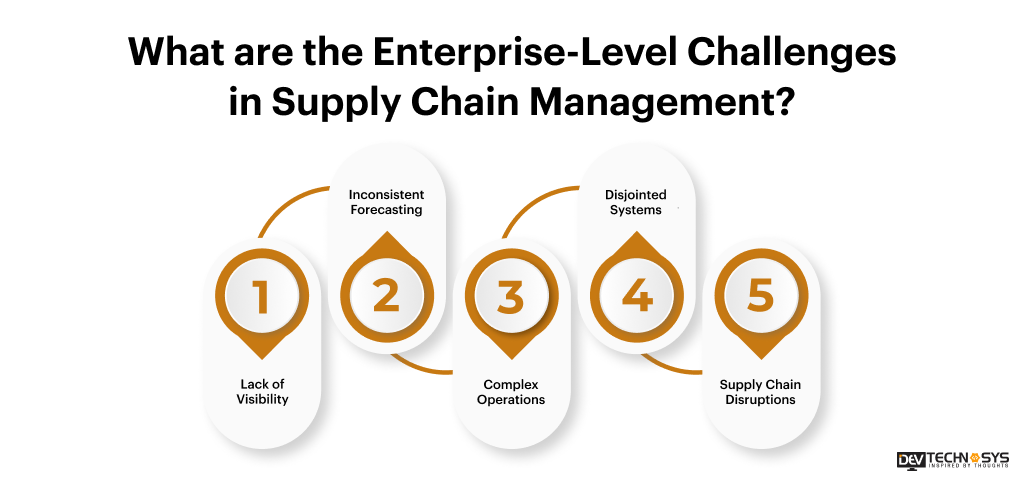
1. Lack of Visibility
Siloed systems and dispersed data across departments and geographies are problems for many businesses. As a result, it is difficult to track inventories without implementing ERP for logistics. Making proactive and well-informed judgments becomes challenging in the absence of end-to-end visibility.
Solution: Implement a centralized ERP system with real-time tracking and analytics dashboards.
2. Inconsistent Forecasting
Overproduction, stock outs, or increased inventory costs can result from inaccurate demand predictions. A lack of predictive analytics and inadequate data integration are the causes of these discrepancies. Consequently, supply chains stop being driven by demand and start acting reactively.
Solution: Leverage AI and machine learning tools for data-driven demand forecasting and trend analysis.
Want a chatbot demo or pricing? Fill the form and talk to our experts today.
Pick what you need below — you can select more than one — then tap Get detail to continue.
-
Chatbot demo dashboard
-
Cost to develop an app
-
Industry report
-
Case study
3. Complex Operations
Operational complexity is increased by managing international suppliers, multimodal transportation, and compliance. Every layer adds factors that need to be coordinated with web portal development services. To avoid delays and inefficiencies, businesses need to optimize these networks.
Solution: Adopt supply chain automation and process optimization tools to simplify workflows.
4. Disjointed Systems
Data flow and communication are hampered by outdated hardware and disjointed software. They result in manual data entry, operational silos, and effort duplication. Collaboration, accuracy, and supply chain performance are all harmed by this disharmony.
Solution: Integrate all supply chain functions using a unified ERP platform for seamless data flow.
5. Supply Chain Disruptions
Supply continuity is disrupted by unforeseen occurrences such as natural catastrophes, pandemics, and geopolitical wars. Contract violations, cost overruns, and shipment delays may result if ERP software for transportation and logistics are not used.
Solution: Use predictive analytics and risk management software to build resilient, agile supply networks.
Benefits of Using ERP Solutions for Logistics and SCM
ERP systems combine several processes into a unified system, simplifying supply chain management and logistics. This cohesive approach increases efficiency, visibility, and decision-making:
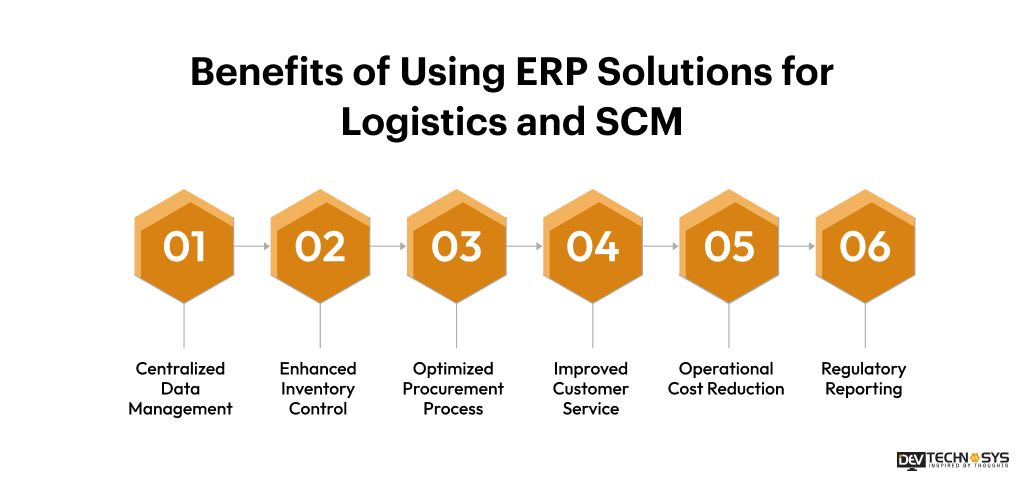
1. Centralized Data Management
ERP systems combine information from sales, transportation, procurement, and warehousing onto a single platform. This improves departmental communication and lessens data silos. Making well-informed strategic decisions is supported by having real-time access to reliable data.
2. Enhanced Inventory Control
ERP makes it possible to precisely track movement, storage sites, and stock levels. By matching inventory to demand, it reduces overstocking or stockouts. You can approach a software product development company for better resource planning and lower carrying costs.
3. Optimized Procurement Process
Contract compliance, supplier management, and prompt replenishment are all guaranteed by automated procurement operations. These systems use approval tracking and real-time pricing comparisons which is one of the most useful benefits of ERP in supply chain management.
4. Improved Customer Service
Improved visibility into inventory and order status allows for quicker resolution of client inquiries. Customer satisfaction is increased by precise delivery schedules and effective fulfillment. Personalized service experiences and proactive communication are also made possible by ERP.
5. Operational Cost Reduction
Routine chores are automated using ERP, which lowers administrative costs and human labor. By using CMS development services, you can find waste and inefficiencies in logistics processes. Strategic resource allocation and budgeting are further supported by integrated analytics.
6. Regulatory Reporting
ERP improves logistics operations and automates audit trails, which aids in compliance maintenance. They provide standardized formats and real-time data accuracy to facilitate regulatory reporting. As a result, audits and inspections are made easier and compliance risks are reduced.
Using AI With ERP Solutions for SCM
ERP solutions for logistics and supply chain management are revolutionized by integrating AI with ERP solutions, which facilitates quicker, more intelligent, and more predictive decision-making.
Artificial intelligence is among the top new technology trends that improves visibility, automation, and response, assisting companies in cutting expenses, increasing productivity, and better satisfying client demands.
- Demand Forecasting: Predicts future demand using historical data and market trends.
- Inventory Optimization: Automatically balances stock levels to reduce overstock and stockouts.
- Predictive Maintenance: Anticipates equipment failures to schedule timely maintenance.
- Smart Procurement: Automates supplier selection and order placement.
- Logistics Route Optimization: Suggests efficient delivery routes to save time and costs.
Top ERP Solutions for Logistics and Supply Chain Management
By providing integrated and scalable systems, ERP solutions are revolutionizing supply chain management and logistics. These are the best ERP systems for streamlining workflows:
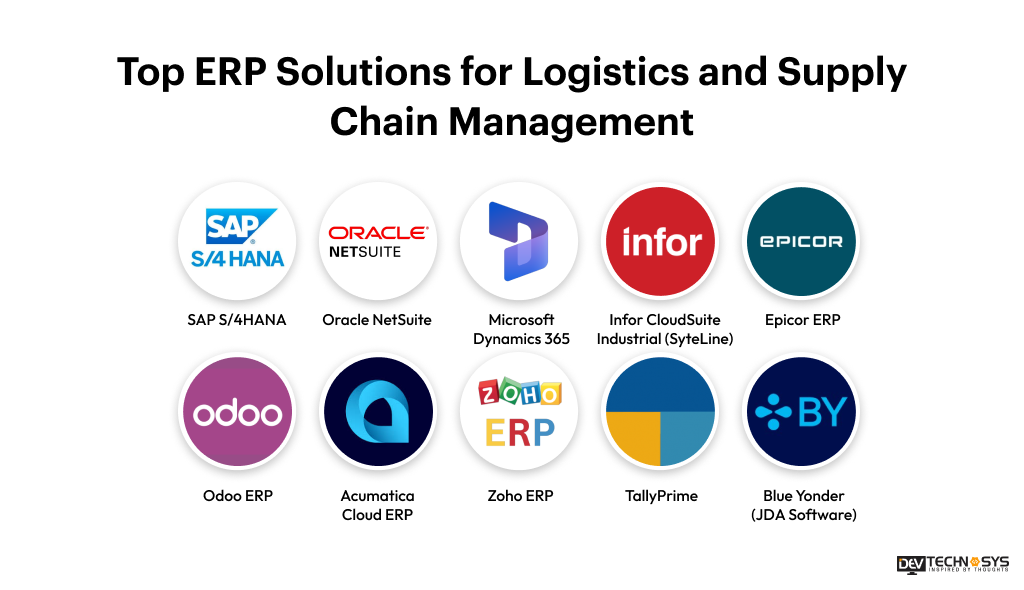
1. SAP S/4HANA
The industry-leading ERP system SAP S/4HANA is renowned for its sophisticated analytics and real-time data processing. It facilitates demand forecasting, inventory optimization, and end-to-end supply chain insight. Its flexible on-premises and cloud deployment options are ideal for businesses with intricate logistics processes.
- Real-time analytics: Provides instant insights for supply chain operations.
- Supply chain planning: Seamlessly connects demand planning and inventory management.
2. Oracle NetSuite
Oracle NetSuite is a cloud-based ERP designed for supply chain and logistics companies that are expanding quickly. Order management, inventory tracking, procurement, and real-time analytics can be integrated with MVP development services. It is perfect for businesses aiming to grow internationally due to its scalability.
- Supply chain visibility: Offers real-time tracking of orders and inventory.
- Automated order fulfillment: Streamlines order processing with automation.
3. Microsoft Dynamics 365
Dynamics 365 is among the top supply chain ERP solutions that streamlines supply chain and logistics operations by combining ERP and CRM features. It makes vendor cooperation, transportation planning, and automated inventory management possible. Departmental cooperation and productivity are increased by integration with Microsoft products.
- AI-driven demand forecasting: Uses machine learning to predict demand.
- Warehouse management: Advanced tools for warehouse operations.

4. Infor CloudSuite Industrial (SyteLine)
Manufacturers and distributors with intricate supply chains are the target audience for Infor CloudSuite Industrial. It has features including demand forecasting, warehouse management, and material planning. Its cloud-first architecture guarantees scalability and real-time collaboration.
- Advanced scheduling: Optimizes production schedules and resource allocation to meet demand.
- Supplier collaboration portal: Enables communication and performance tracking.
5. Epicor ERP
The logistical requirements of manufacturing and distribution companies are addressed by Epicor ERP. an enterprise product development company can use this to facilitate production planning, supplier management, and inventory control. Its adaptable architecture enables cloud or on-premise deployment.
- Supply chain traceability: Tracks materials and products throughout the entire supply chain.
- Flexible inventory management: Supports multi-location for complex inventory needs.
6. Odoo ERP
Odoo is the best ERP for logistics companies that offers modular logistics, procurement, and inventory solutions. It is perfect for SMEs because of its price and customisation possibilities. Third-party connectors are also supported by Odoo for increased functionality.
- Integrated logistics management: Combines inventory and shipping management.
- Real-time inventory updates: Provides live inventory levels with automated reordering triggers.
7. Acumatica Cloud ERP
A cloud-native ERP system designed for supply chain management and real-time logistics is called Acumatica. Order processing, inventory tracking, and warehouse automation are among its functions. Mid-sized businesses benefit from its scalability and user-friendly design.
- Warehouse management: Features barcode scanning and automated replenishment.
- Demand and supply planning: Tools for balancing demand forecasts with supply chain capacity.
8. Zoho ERP
For small to medium-sized logistics companies, Zoho ERP provides a portable yet effective solution. It is a cloud-based solution that incorporates vendor portals, order administration, inventory, and invoicing. You can hire software developers to improve business process automation with Zoho apps.
- Inventory management: Centralized control over stock levels, sales orders, and purchase orders.
- Supplier management: Tracks vendor performance, contracts, and payments.
9. TallyPrime
Small logistics companies frequently use TallyPrime for financial and inventory management. It makes GST compliance, stock movement tracking, and invoicing easier. It is effective for basic logistics accounting even though it lacks sophisticated SCM functionality.
- Inventory tracking: Supports batch-wise and expiry-date tracking of inventory.
- Supply chain accounting: Integrated finance for seamless procurement and payment processes.
10. Blue Yonder (JDA Software)
It is one of the best real-time tracking ERP systems for advanced logistics and supply chain planning. It is very good at transportation management, demand forecasting, and logistical insights driven by AI. Large-scale supply chain optimization is supported by its robust analytics and forecasting technologies.
- Supply chain optimization: Uses advanced algorithms to optimize transportation and labor.
- End-to-end visibility: Real-time monitoring of shipments and inventory across the network.
Key ERP Features for Logistics and SCM
Supply chain management and logistics ERP systems include strong features that centralize data. These features are essential for streamlining supply chain operations, from purchasing to shipping and refunds:
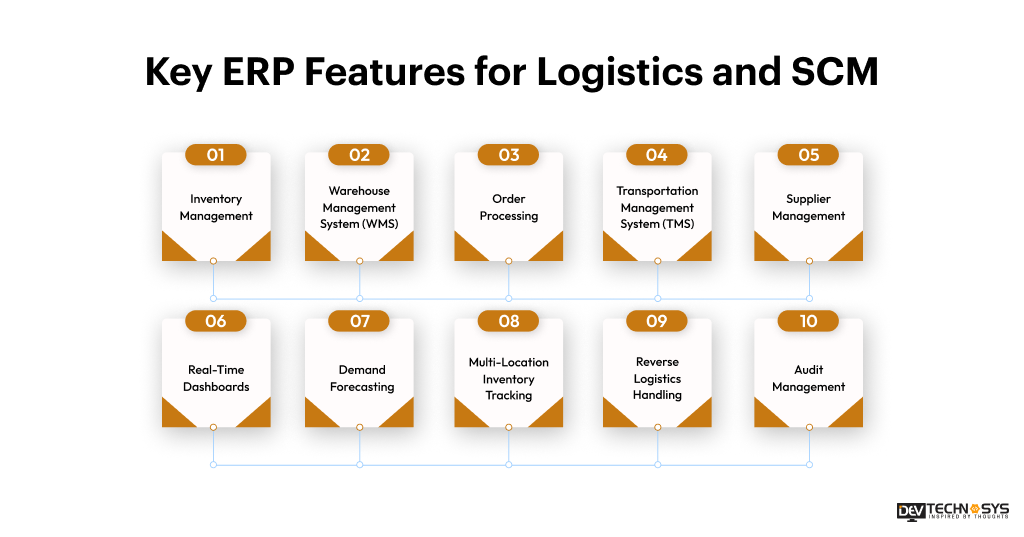
1. Inventory Management
Monitors stock levels, tracks movement, and automates replenishment to prevent shortages or overstocking. Helps maintain optimal inventory levels across multiple locations with real-time accuracy.
2. Warehouse Management System (WMS)
Streamlines warehouse operations, including picking, packing, and storage. You can develop an ERP system to improve space utilization and reduce manual errors in logistics handling.
3. Order Processing
Logistics and supply chain ERP automates sales order creation, tracking, and fulfillment. Ensures timely delivery and reduces processing delays through real-time system updates.
4. Transportation Management System (TMS)
Plans, executes, and optimizes transportation and shipping processes. Enables carrier selection, route optimization, and cost analysis for efficient logistics.
5. Supplier Management
A custom software development company in USA helps to centralize supplier information and performance metrics. Facilitates better negotiation, contract management, and procurement planning.

6. Real-Time Dashboards
Displays live operational data like shipment status, stock levels, and order flows. Enhances decision-making with quick insights and visual analytics.
7. Demand Forecasting
ERP software for supply chain management uses historical data and AI to predict future product demand. Reduces stockouts and supports smarter production and procurement strategies.
8. Multi-Location Inventory Tracking
Tracks inventory across warehouses, distribution centers, and retail outlets. By using CRM development services, you can ensure accurate visibility and seamless stock transfers between locations.
9. Reverse Logistics Handling
Manages product returns, repairs, and exchanges efficiently. Improves customer satisfaction and helps recover value from returned goods.
10. Audit Management
Maintains detailed logs and compliance records for regulatory reporting. Simplifies internal audits and enhances transparency across logistics operations.
How to Implement ERP Solutions With Supply Chain Management?
Implementation of ERP solutions for logistics and supply chain management is a strategic approach to match technology with operational objectives. It guarantees smooth integration and efficiency:
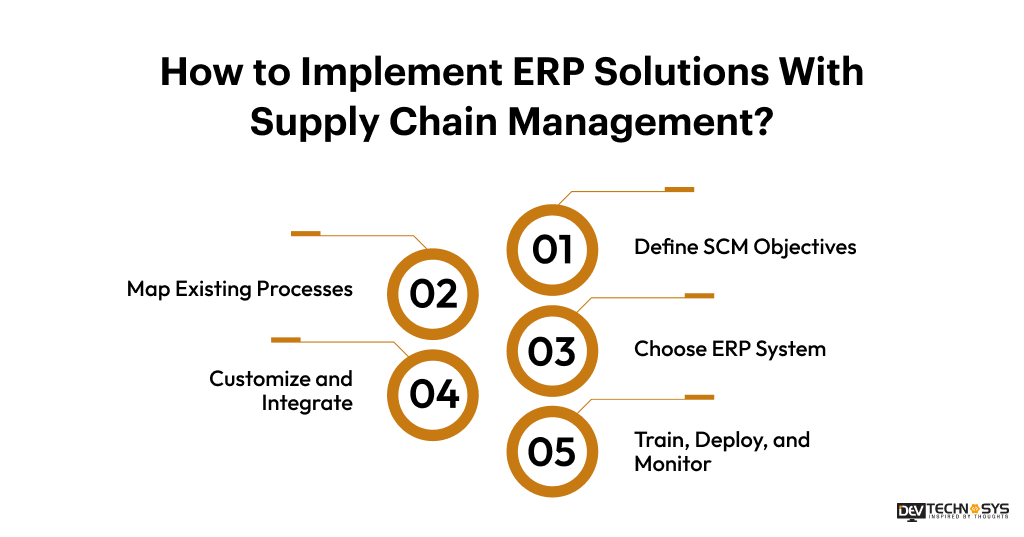
1. Define SCM Objectives
Start by laying out your supply chain management company objectives in detail. ERP implementation in logistics and supply chain helps to solve problems including lack of visibility, inventory inconsistencies, or delays. Set KPIs such as cost savings, increased order accuracy, or lead time reduction. These goals will direct the choice and modification of ERP.
- What are the key supply chain challenges?
- Which KPIs should we track?
- How do our SCM goals align with business objectives?
2. Map Existing Processes
Record the existing supply chain processes, from acquisition to delivery. Provide information about order management, warehouse operations, transportation, and inventory flow. Examine any gaps, redundancies, or inefficiencies that the ERP system should fix. Involve important parties from the procurement, operations, and logistics departments.
- What are the current workflows?
- Where are the inefficiencies in existing SCM operations?
- Which stakeholders should be involved?
3. Choose ERP System
Choose an ERP system that meets your SCM and logistics needs. Think about vendor support, integration capabilities, cloud/on-premise preferences, and scalability. Depending on your size and budget, you can hire dedicated developers to implement SAP, NetSuite, or Microsoft Dynamics. Make sure the system can adjust to the regulatory requirements unique to your sector.
- Which ERP systems best fit our industry?
- Does the ERP support necessary integrations ?
- What is the total cost of ownership?
4. Customize and Integrate
ERP systems for supply chain management can be customized to match your unique business structure and procedures. Connect with current systems like financial software, CRM, TMS, or WMS. To provide smooth data transfer between platforms, develop middleware or APIs. Verify that data migration procedures and security measures are in place.
- What features need customization?
- How will the ERP integrate with databases?
- What security standards should the integration process meet?
5. Train, Deploy, and Monitor
Provide thorough training to staff members in all departments. To reduce operational risk and guarantee uptake, implement the ERP in stages. Provide a support network for troubleshooting and immediate problem solving. Keep a close eye on user feedback and performance indicators. For scalability and changing requirements, the system should be updated and optimized as necessary.
- What training programs are needed?
- Should we opt for full-scale ERP deployment?
- How will we track system performance?
Future Trends in ERP for Logistics Industry
Technological developments that improve sustainability and transparency are causing the logistics sector to change quickly. Cutting-edge technologies will be progressively incorporated into future ERP systems:
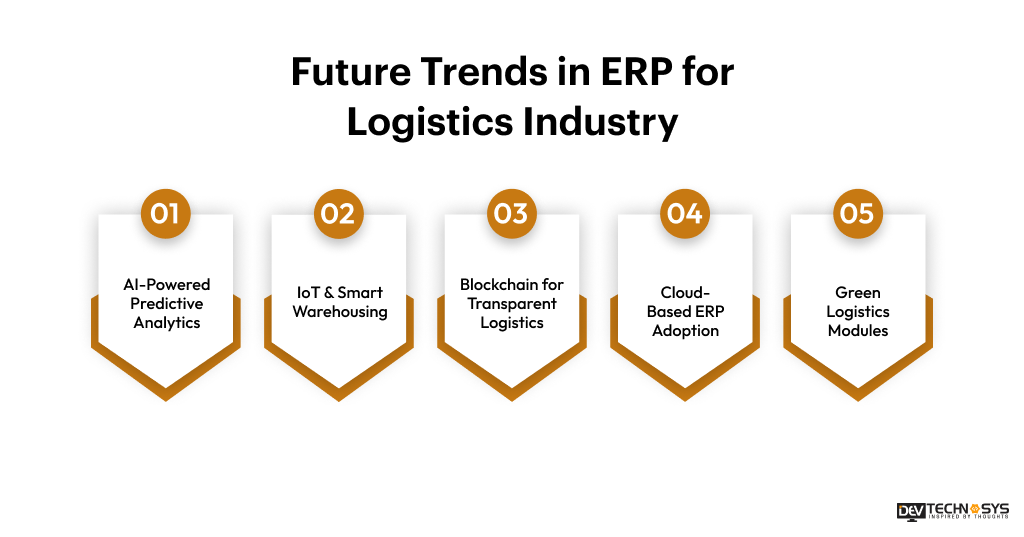
1. AI-Powered Predictive Analytics
Logistics firms can forecast demand, optimize routes, and foresee issues before they happen with AI-driven predictive analytics. ERP providers for supply chain may use AI to facilitate proactive decision-making that lowers expenses and raises service standards by evaluating historical data.
2. IoT & Smart Warehousing
By giving real-time information on inventory levels, equipment status, and environmental factors, Internet of Things (IoT) devices turn warehouses into smart spaces. By using sensors and networked devices, smart warehousing enhances asset tracking and streamlines processes.
3. Blockchain for Transparent Logistics
Throughout the logistics supply chain, blockchain technology guarantees safe, unchangeable, and transparent record-keeping. By offering a single source of truth for transactions and shipment tracking, these software development trends aid in the eradication of fraud and mistakes.
4. Cloud-Based ERP Adoption
Cloud ERP for logistics industry provides cost-effective, scalable, and adaptable solutions for the ever-changing demands of logistics operations. They facilitate remote access, allow for smooth interaction with other digital tools, and facilitate real-time collaboration amongst multinational teams.
5. Green Logistics Modules
ERP modules with a sustainability focus monitor carbon footprints, maximize fuel efficiency, and oversee environmentally friendly packaging and shipping choices. These resources assist logistics companies in meeting consumer demands for green operations and environmental requirements.
In a Nutshell!!
Using ERP solutions for logistics and supply chain management may help you to operate all business processes easily and in an efficient manner. You must follow a few precautions before integration ERP systems with existing services:
- Target reliable ERP development frameworks and technologies at lower costs.
- Use custom ERP solutions for logistics that are flexible and can be easily implemented.
- Study various business models that use advanced ERP systems.
- Keep an adjustable budget that can be managed whenever required.
It is necessary to ensure these points while implementing the modern ERP solutions with old SCM systems. This will increase your growth and help to gain profits.
FAQs
1. What are ERP Solutions for Logistics and Supply Chain Management?
- ERP in logistics manages core supply chain activities.
- It centralizes data and automates operations like order processing.
- The system enables coordination and efficiency.
2. How Does an ERP System Benefit Logistics Companies?
- Improves real-time tracking.
- Automates repetitive tasks and reduces human errors.
- Enhances customer service with responsive support.
3. What are the Essential ERP Modules for Logistics and SCM?
- Warehouse Management – tracks stock levels, locations, and movements.
- Supplier Management – handles purchasing, vendor relationships, and orders.
- Order Management – manages shipment planning, delivery tracking, and fulfillment.
4. Can Small and Mid-Sized Logistics Businesses Afford ERP Solutions?
Yes, a large number of ERP providers provide cloud-based, scalable solutions made especially for small and medium-sized logistics businesses. These systems offer flexible pricing options, such as monthly subscriptions, and modular functionality.
5. How Long Does it Take to Implement an ERP System in Logistics?
Depending on the size of the company and the complexity of the system, ERP implementation times normally vary from three to nine months. This covers phases including gathering requirements, customizing, integrating, migrating data, and training users.
6. What are the Risks of not Using ERP in Supply Chain Management?
- Data Silos – Disconnected systems cause inconsistent and unreliable data.
- Inefficient Operations – Manual processes slow down workflows and increase errors.
- Poor Planning – Lack of real-time data hinders forecasting.