

















Businesses that deploy LLM agents are cutting operational costs by 30% to 40% while serving customers 24/7 at scale. However, developing and launching a custom LLM agent is a complex and costly task, if not done right.
This guide walks business owners, CEOs, and decision-makers through the complete LLM development process, showing them how to develop an LLM Model successfully for today’s market and users.
From choosing an architecture to going live, we will explore the art, science, and strategy used to develop a rich-feature LLM agent. We will also highlight best practices to optimize LLM agent performance, ensuring data security and operational cost-cutting for the long term.
Additionally, his blog will offer helpful insights regarding how to scale your LLM agent to meet evolving business demands and user expectations.
Read More!
LLM Market Analysis: Why 2026 Is the Right Time to Invest in LLM Development
Investing in LLM development services is a profitable venture for businesses that wish to enter this competitive market. Businesses looking for speed, cost-efficiency, and expert support prefer LLM development services more, while enterprises seeking strong technical teams often opt for in-house development for better control and long-term precision.
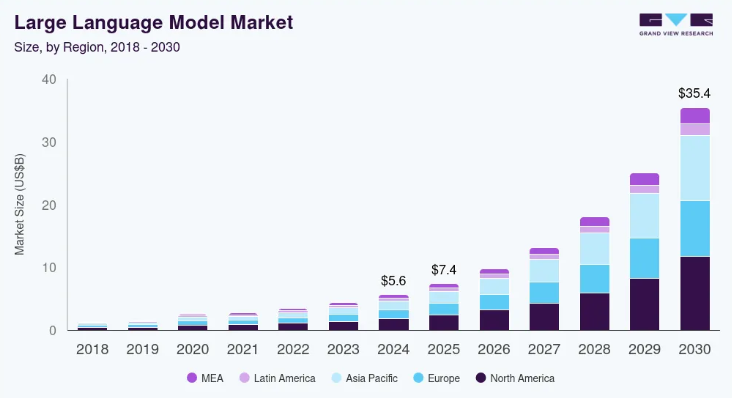
- As per the global reports, the large language models were valued at around $5,617 million in 2024. It is projected to grow to around $35,434 million by the end of 2030.
- According to the segment-wise, the chatbots and virtual assistant segment holds the largest market revenue share, around 26.8% in 2024.
- In a recent survey, the LLM model is expected to increase with a CAGR of 36.9% from 2025 to 2030.
- Looking at the industry-wise, the retail and e-commerce segment accounts for the highest revenue share in 2024.
- North America dominates the large language model market by holding its largest revenue share of around 32.1% in 2024.
What is an LLM and How Does an LLM Agent Work?
However, an LLM agent is more than just a text generator. Although LLM is the core model, an LLM agent is a system that is autonomous and leverages a model to reason, make decisions, and take actions.
It does that by interacting with APIs, tools, or external data sources. Basically, LLMs provide intelligence, while the LLM agents make use of the intelligence to manage workflows and perform real-world tasks.
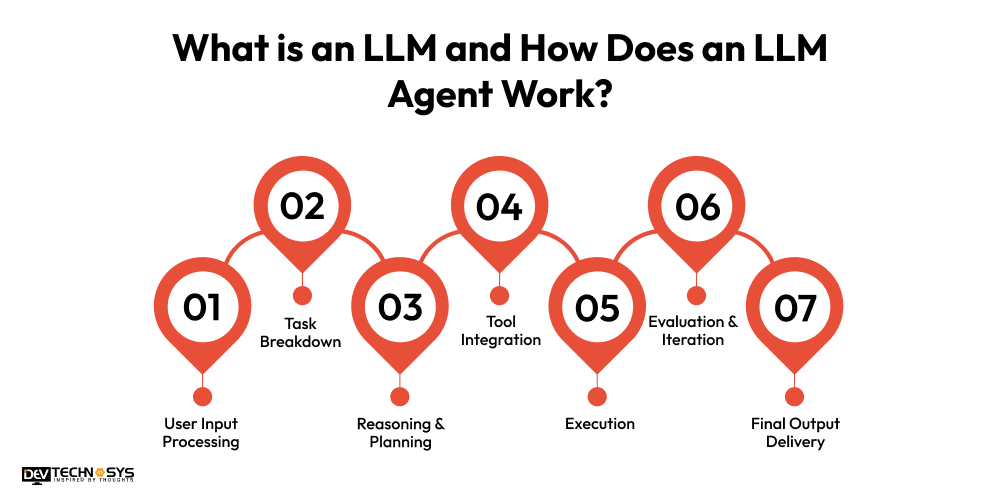
Now let’s see how the LLM agent works:
1. User Input Processing:
First, the LLM Agent receives a user query and uses the LLM to understand the intent, context, and requirements, which ensures an accurate understanding before taking further action or executing a task.
2. Task Breakdown:
The agent divides complex user requests into smaller, structured steps, making it easier to process tasks efficiently while ensuring logical sequencing and better execution of multi-step workflows.
3. Reasoning & Planning:
LLM agent evaluates the task, applies logical reasoning, and determines the most effective strategy to achieve the desired outcome, considering available data, tools, and possible approaches.
4. Tool Integration:
The agent connects with external systems such as APIs, databases, or software tools to retrieve real-time data, perform actions, and enhance its capabilities beyond basic text generation.
5. Execution:
LLM uses predefined logic and real-time inputs to execute planned actions such as fetching information, triggering workflows, or sending requests. It ensures the completion of tasks accurately.
6. Evaluation & Iteration:
The agent continuously analyzes outputs, identifies errors or gaps, and refines its approach through iterative steps to improve accuracy, efficiency, and overall task performance.
7. Final Output Delivery:
After completing all steps, the agent delivers a comprehensive, context-aware response or final result, ensuring it aligns with user intent and successfully fulfills the requested objective.

Why Your Business Needs Custom LLM Development Services in 2026?
Want to grow your business? Large language model engineering can help you chat with customers better, save time by automating tasks, understand your data, cut costs, and handle more work easily. Keeping your business ahead and running smoothly.
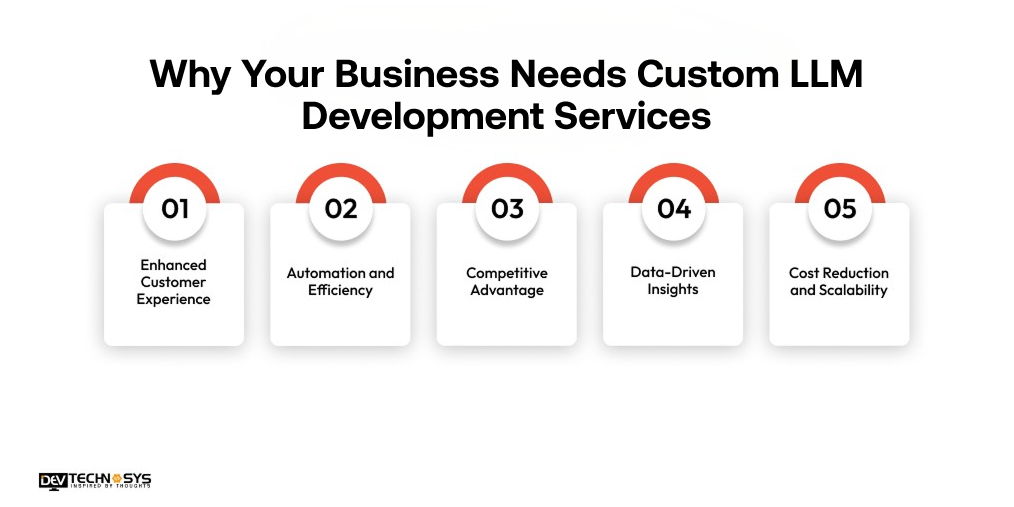
1. Enhanced Customer Experience
Businesses build an AI agent to provide instant, accurate, and personalized customer support, improving satisfaction and engagement while reducing operational costs associated with human agents, enabling scalable 24/7 service across multiple languages and channels.
2. Automation and Efficiency
LLMs automate repetitive tasks like data entry, content generation, and report summarization. This can reduce the human tasks and enable a focus on growth. This boosts productivity, reduces errors, and accelerates business processes, leading to faster decision-making and operational savings.
3. Competitive Advantage
Custom LLMs tailored to specific industries or company data give businesses unique insights and capabilities. This differentiation helps them innovate faster, deliver better products or services, and stay ahead of competitors in a rapidly evolving market.
4. Data-Driven Insights
LLMs analyze vast amounts of unstructured text data, customer feedback, social media, and reports, extracting trends and sentiments. According to the AI development company, these insights inform smarter marketing, product development, and risk management strategies, enhancing overall business intelligence.
5. Cost Reduction and Scalability
Investing in LLMs reduces reliance on large human teams for communication and content creation. Once deployed, models scale effortlessly to handle growing demands, offering cost-effective solutions with consistent quality across multiple applications and user bases.
Top LLM Models for Business App Development: Which One Should You Build On?
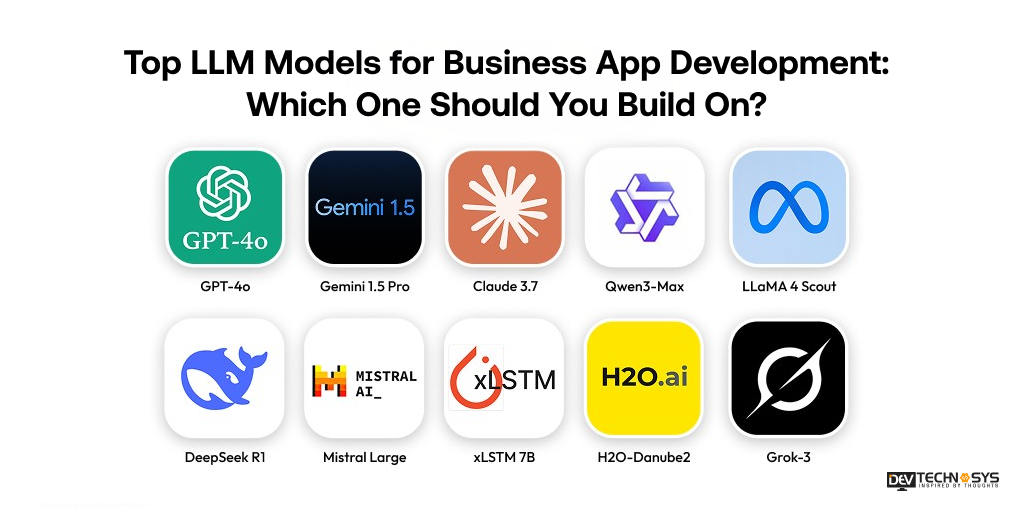
Choosing the right base model is the first key decision in your LLM development process. Here’s the list of top LLM models that power modern business applications, enable intelligent automation, and support scalable AI-driven solutions across industries.
Model |
Developer |
Key Features |
Use Cases |
| GPT-4o | OpenAI | Multimodal (text, image, audio), High reasoning ability | Coding, content creation, data analysis |
| Gemini 1.5 Pro | Google DeepMind | 1M token context Deep Google Workspace integration | Research, enterprise productivity, and education |
| Claude 3.7 | Anthropic | 200K token context Safety & interpretability | Chatbots, document processing, and ethical AI systems |
| Qwen3-Max | Alibaba | 1T+ parameters Leading in code & agent tasks | Autonomous agents, AI-powered business tools |
| LLaMA 4 Scout | Meta | Open-source High benchmark scores | Custom AI apps, academic research |
| DeepSeek R1 | DeepSeek | 671B total params Excels in math/coding | Scientific computing, technical Q&A |
| Mistral Large | Mistral AI | Open-weight Fast and efficient | Real-time use, embedded AI, chatbots |
| xLSTM 7B | xLSTM | Linear scaling Constant memory usage | Edge AI, mobile, low-resource environments |
| H2O-Danube2 | H2O.ai | 1.8B params Top-ranked small model | Lightweight AI apps, quick prototyping |
| Grok-3 | X (formerly Twitter) | Real-time web data integrated with a social platform | News summarization, moderation, and live user support |
1. GPT-4o (OpenAI)
GPT-4o by OpenAI processes texts, images, and audio using strong logic and reasoning ability. This multimodal model is often used to create content, analyze data, and perfect coding. GPT-40 is ideal for businesses seeking versatile AI solutions for automations, communications, and advanced problem-solving capabilities across industries.
2. Gemini 1.5 Pro (Google DeepMind)
Gemini 1.5 Pro offers a 1 million token context window and seamlessly integrates with Google Workspace tools. Enterprises can use GEmini 1.5 pro for research, enterprise productivity, and education. It enables users to effectively manage large datasets, documents, and complex workflows.
3. Claude 3.7 (Anthropic)
Claude 3.7 focuses on safety, interpretability, and responsible AI usage. more than anything. This model is best suited for chatbots, document processing, and compliance-focused applications, making sure that results are always reliable. Claude 3.7 maintains ethical standards in AI-driven interactions and enterprise systems.
4. Qwen3-Max (Alibaba)
As one of the high-performance models, Qwen3-Max has over 1 trillion parameters. It is best used for coding and performing autonomous agent tasks. It is used to build AI-powered business tools and smart agents that ensure automation, advanced reasoning, and scalable enterprise-level solutions.
5. LLaMA 4 Scout (Meta)
LLaMA 4 Scout is known for its strong, high-standard performance and flexibility. Businesses often use this model to create custom AI applications and academic research, allowing developers to fine-tune models and create tailored AI solutions with greater control and transparency.
LLM Development Process: 7 Steps to Build and Deploy Your LLM Agent
To build an LLM model, you must consider the basic or advanced requirements and follow each step for successful Rust LLM and language model development. From market research to post-launch maintenance services, we defined each step in depth. So, here we provide the Chatbot development services process:
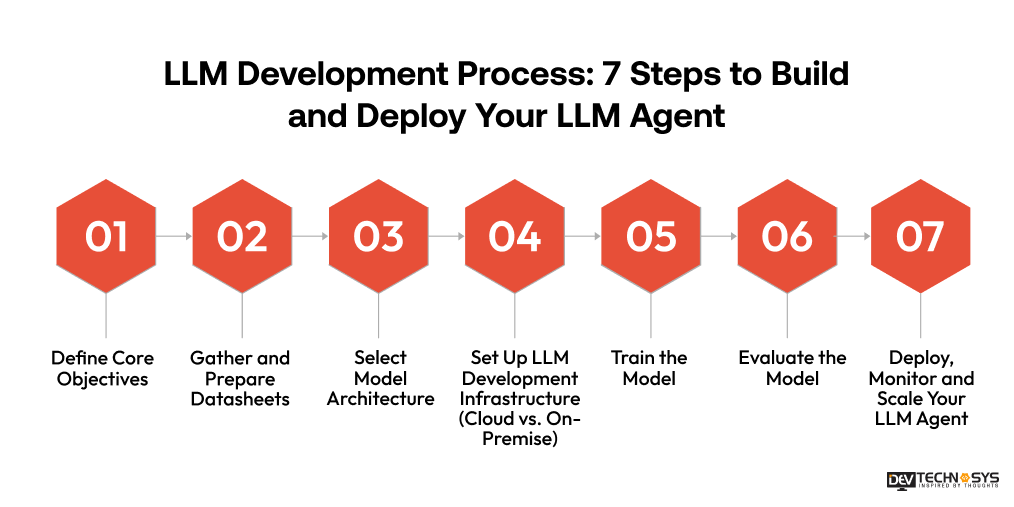
1. Define Core Objectives
In the first step to develop an LLM model, define the core objectives that your LLM model should perform, such as legal advice, coding, general chat, and more.
Clear the goals first with proper guidance and make a plan to compete with the competitors and gain a good outcome. This are the important steps to avoid wasted effort and ensure that you deal with real-world use cases.
2. Gather and Prepare Datasheets
Moving to the second stage, hire developers from a Generative AI development company to collect the huge amount of data from websites, books, chats, and more. When building LLMs from scratch, make sure that the data is relevant to every query and clean the data that is duplicate, fake, and in broken formats.
3. Select Model Architecture
Let’s come to the third step to make an LLM Model: select the transformer-based model that is perfect for the use case. There are various types of models that exist, such as decoder-only, encoder-only, and encoder-decoder. Using the open source blueprints like Mistral, GPT-2, and LLaMA.
4. Set Up LLM Development Infrastructure (Cloud vs. On-Premise)
In the fourth stage, to create an LLM Model, choose between local clusters or cloud platforms (AWS, GCP, Azure). Use GPUs like A100 or TPUs for efficient processing.
Hire professional developers from a Chatbot development company to install libraries such as PyTorch, Transformers, DeepSpeed, or Megatron-LM. Set up distributed training for large models.
5. Train the Model
Begin with small test runs to validate your setup. Training an LLM model: pretraining on large datasets and commanding it with real data. Use mixed precision for speed and efficiency.
LLM pretraining steps: track loss, validation metrics, and anomalies. Checkpoints regularly to avoid data loss. Training may take weeks and require multiple iterations. Optimization strategies like gradient clipping
6. Evaluate the Model
Coming to the sixth step to develop an LLM model, assess the model’s performance using metrics like perplexity, BLEU, or accuracy, depending on the task.
Generate sample outputs to inspect coherence and reasoning. Perform robustness, bias, and safety tests to identify harmful behaviors. Compare against benchmarks like MMLU or HELM.
7. Deploy, Monitor and Scale Your LLM Agent
Move to the final step to create an LLM Model, package the model using inference tools like vLLM, ONNX, or Triton for LLM deployment strategies. Host it on a scalable infrastructure with APIs or endpoints.
Apply quantization or distillation to reduce latency and size. Hire a mobile app development company to set up monitoring for usage, latency, errors, and user feedback.
You can reach out anytime; we are available 24/7. Our team provides a quick response.

LLM App Development: How Businesses Are Building AI-Powered Applications
The goal of LLM developing applications is to make apps that employ Large Language Models to interpret, create, and act on human language. LLM-based apps are different from conventional AI apps since they focus on activities like conversational AI, content development, document analysis, and smart automation for both enterprises and regular people.
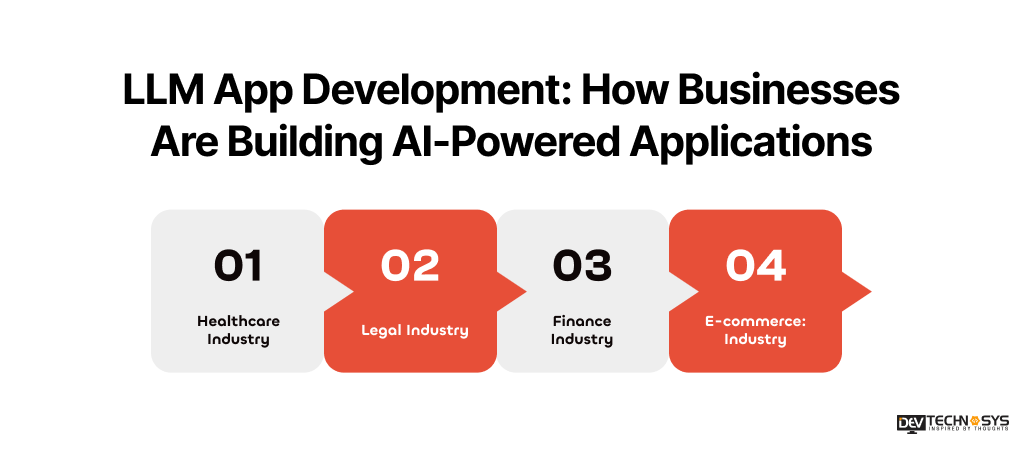
Real-world examples By Industry:
1. Healthcare Industry:
LLM agents help hospitals and pharmacies answer patient questions, write clinical notes, and summarize medical records.llm agent development in helthcare industry helps them reduce the amount of work that needs to be done by administrators, increases efficiency, and lets healthcare professionals spend more time caring for patients.
Examples: Nuance Communications (Microsoft) and Mayo Clinic
2. Legal Industry:
Law companies use LLM agents to assist lawyers save a lot of time by analyzing contracts, doing legal research, and writing documents. This also makes sure that the documents are accurate, consistent, and follow all the complicated rules and standards for legal documents.
For example: Allen & Overy
3. Finance Industry
LLM agents help companies like Amazon make personalized suggestions, chatbots, and manage orders automatically. This improves the customer experience, keeps customers interested, and boosts sales and conversion rates.
Shopify and Amazon are two examples.
4. E-commerce: Industry
Banks and fintech businesses utilize LLM agents to find fraud, automate customer service, and get financial information. This helps them make decisions faster, manage risks better, and follow rules and security requirements better.
Examples: JPMorgan Chase, Morgan Stanley
Different Types of Large Language Models
Explore three powerful large language models: Transformer-based, RNN, and Encoder-Decoder, each uniquely designed to understand, generate, and transform human language for diverse AI applications and tasks.
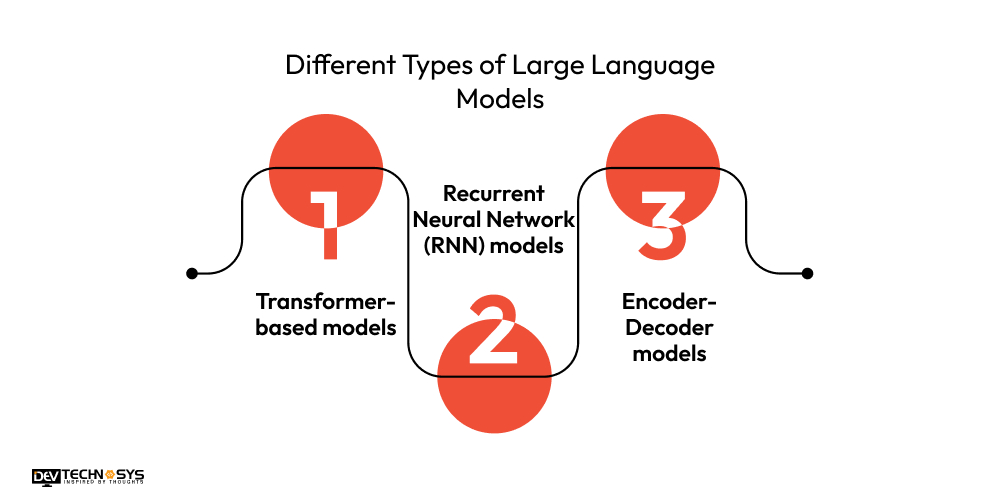
1. Transformer-based models
Use attention mechanisms to process language, enabling understanding of context and relationships in text. Examples include GPT and BERT. They excel at tasks like translation, summarization, and text generation by predicting words based on context.
2. Recurrent Neural Network (RNN) models
Process sequences of words step-by-step, maintaining memory of previous inputs. Effective for sequential data but limited by long-range dependencies. Variants like LSTM and GRU improve performance in language modeling and speech recognition.
3. Encoder-Decoder models
It means an encoder processes the text and generates the output, which is called a decoder. Widely used in translation and summarization tasks. Examples include the original Transformer model and sequence-to-sequence frameworks.
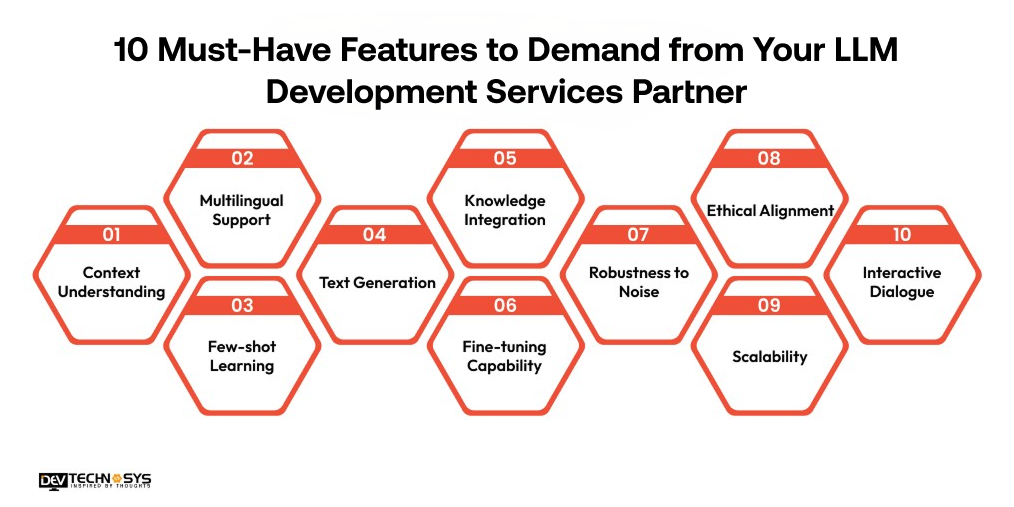
10 Must-Have Features to Demand from Your LLM Development Services Partner
Discover essential features of large language models, from context understanding to ethical alignment, powering accurate, versatile, and responsible AI-driven language applications worldwide.
-
Context Understanding
Accurately comprehends surrounding text to generate relevant and coherent responses in varied conversations or documents.
-
Multilingual Support
Handles multiple languages fluently, enabling global communication and translation without losing meaning or nuance.
-
Few-shot Learning
Learns new tasks quickly from limited examples, reducing the need for extensive retraining or large datasets.
-
Text Generation
Natural language processing services produce human-like, creative, and contextually appropriate text for diverse applications like writing, chatbots, and storytelling.
-
Knowledge Integration
Incorporates vast external knowledge bases to provide accurate, factual, and up-to-date information.
-
Fine-tuning Capability
Easily customizable for specific tasks or domains, improving accuracy and relevance in targeted applications.
-
Robustness to Noise
Maintains performance despite typos, slang, or incomplete input, ensuring reliability in real-world usage.
- Ethical Alignment
Incorporates guidelines to minimize biases, harmful content, and misinformation during interaction and generation.
-
Scalability
Efficiently operates across various hardware setups, from powerful servers to edge devices, enabling versatile deployment.
-
Interactive Dialogue
Machine learning development solutions support multi-turn conversations with memory, understanding context, and intent for seamless user engagement.

LLM Development Cost: What Businesses Actually Pay in 2026 (Full Breakdown)
The cost to develop an LLM model is around $8,000 to $25,000, depending on the custom requirements. It can fluctuate due to various reasons or factors like premium features, backend infrastructure, third-party integrations, deployment platforms, and many more.
Consider the extra factors that can also affect the cost to build artificial intelligence project, like app complexity, tech stacks, security approaches, and maintenance.
Explore the key factors that has the ability to impact the LLM Model development cost:
1. Development Team:
The developer’s team can impact the cost to develop an LLM model; some of the developers who have higher experience in development can demand a higher salary package. And developers’ locations can also affect the cost, because every region has different living costs.
2. Design UI/UX:
It is one of the most common factors; designing a user interface can be complex sometimes. It includes various types of elements such as templates, themes, built-in plugins, fonts, styles, colors, layouts, and more. Design tools are also highly paid, which can have a direct impact on AI agent development cost.
3. Third-Party Integrations:
Integrating third-party tools and applications is expensive because ot their higher licensing and developers take more time to implement. It includes various types of third-party integrations such as productivity tools, cloud services, database access, and API calls. These can influence the final LLM model development cost.
4. Maintenance and Support Services:
To keep the system up-to-date and maintain the actual speed, conduct maintenance and support services. It involves different services such as fixing bugs, regular backups, solving security issues, and updating outdated features. These services can take time to complete, which can increase the overall cost to develop a Chatbot.
Category |
Estimated Cost |
Description |
| Data Collection & Cleaning | $2,000 – $5,000 | Gathering and preprocessing training data |
| Model Selection & Licensing | $1,000 – $3,000 | Choosing base models or licensing pre-trained models |
| Fine-Tuning / Training | $3,000 – $10,000 | Compute costs for training/fine-tuning the model |
| Infrastructure & Cloud Costs | $1,500 – $4,000 | Cloud compute and storage fees |
| Evaluation & Testing | $500 – $1,500 | Model evaluation, validation, and debugging |
| Deployment & Maintenance | $1,000 – $2,500 | Serving the model in production, ongoing support |
Total Development Cost: $8,000 – $25,000+
How Businesses Monetize Custom LLM Development Investments?
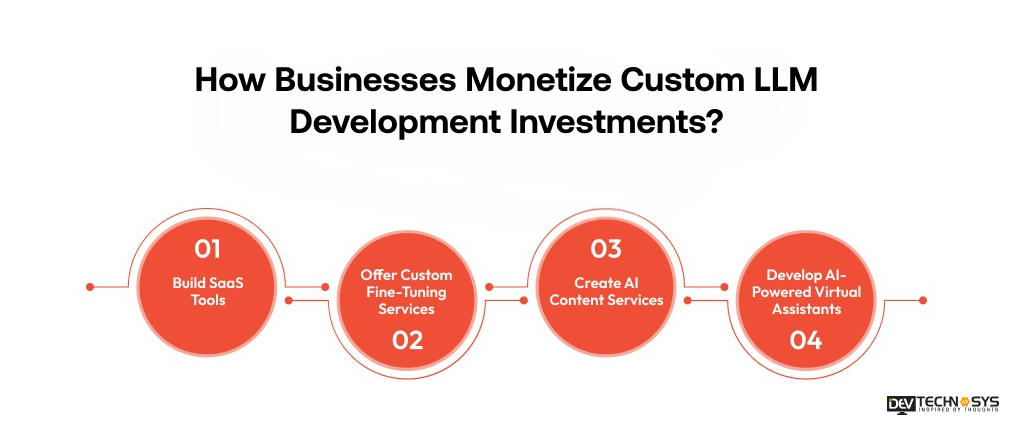
1. Build SaaS Tools
Create an AI app that uses LLMs for content generation, chatbots, or customer support. Offer subscription plans to businesses or individuals who need AI-powered writing, automation, or communication solutions, generating steady revenue through recurring fees.
2. Offer Custom Fine-Tuning Services
Help companies improve LLM performance by fine-tuning models on their own data. Charge consulting fees for training specialized versions that better understand specific industries or tasks, providing more accurate and valuable AI outputs tailored to client needs.
3. Create AI Content Services
With the help of an LLM model, generate blogs, advertising, content, and more. Sell these as a service to brands and agencies looking for fast, affordable content creation, saving them time while delivering high-quality, relevant text for their campaigns.
4. Develop AI-Powered Virtual Assistants
Develop a chatbot app like Grok that handles customer queries automatically. Monetize through licensing, subscriptions, or usage fees by helping businesses reduce support costs and improve user engagement with AI-driven conversations.
5. License LLM APIs
Create an API that offers access to your LLM-powered features, like text generation, summarization, or translation, and charge developers or companies based on API calls or subscription tiers. This scalable model earns money as usage grows across diverse applications.

Conclusion: Is Custom LLM Development the Right Move for Your Business?
For sure, businesses should invest in LLM app development if they handle 500+ customer queries daily. It helps businesses by ensuring faster automation and responses, and improved customer experience. For enterprises wanting to minimize content creation and operational costs by 30% or more, they can go for LLMs that deliver measurable efficiency gains.
Partnering with Dev Technosys, an experienced LLM development company with 10+ years of expertise in LLM Agent development, ensures faster deployment, scalability, and long-term success.
Frequently Asked Questions
Find answers to the most common questions related to this article.
The best Rust libraries for building large language models include burn, tch-rs (bindings for PyTorch), ndarray, and rust-bert. These offer tools for complex operations, LLM training data preprocessing, and inference, combining performance with Rust’s safety features. These libraries help developers build efficient, scalable, and secure LLM applications with improved performance and system reliability.
Rust has expertise in secure memory, making it ideal for language model projects. Compared to Python or C++, it reduces runtime errors, ensures thread safety, and delivers near-C-level speed without sacrificing code reliability or maintainability. This makes Rust highly suitable for production-grade AI systems requiring performance, safety, and long-term maintainability at scale.
Leading providers of custom large language model development services include OpenAI, Google DeepMind, Anthropic, Meta, Amazon, Microsoft, Cohere, AI21 Labs, Mistral AI, and Baidu, offering advanced AI tools and custom model solutions. These companies provide enterprise-grade AI infrastructure, APIs, and tools to accelerate LLM development and deployment across industries.
Here are the key steps involved in LLM model development:
Data Collection
Data Preprocessing
LLM Model Architecture Design
Training
Evaluation
Fine-Tuning
Deployment
Following these steps ensures a structured approach to building accurate, scalable, and high-performance large language models for real-world applications.
Large language model development involves customizing it by fine-tuning on domain-specific data, optimizing prompts, integrating relevant APIs, and continuously evaluating performance to align with business goals and user requirements. This approach ensures the model delivers accurate, context-aware responses tailored to your specific industry and customer use cases.
Latest trends in large language model customization include fine-tuning with domain-specific data, efficient parameter tuning (like LoRA), on-device deployment, prompt engineering, and leveraging advanced LLM architectures for scalable, secure, and real-time AI applications. These innovations are enabling faster deployment, lower costs, and improved performance for modern AI-powered business solutions.